
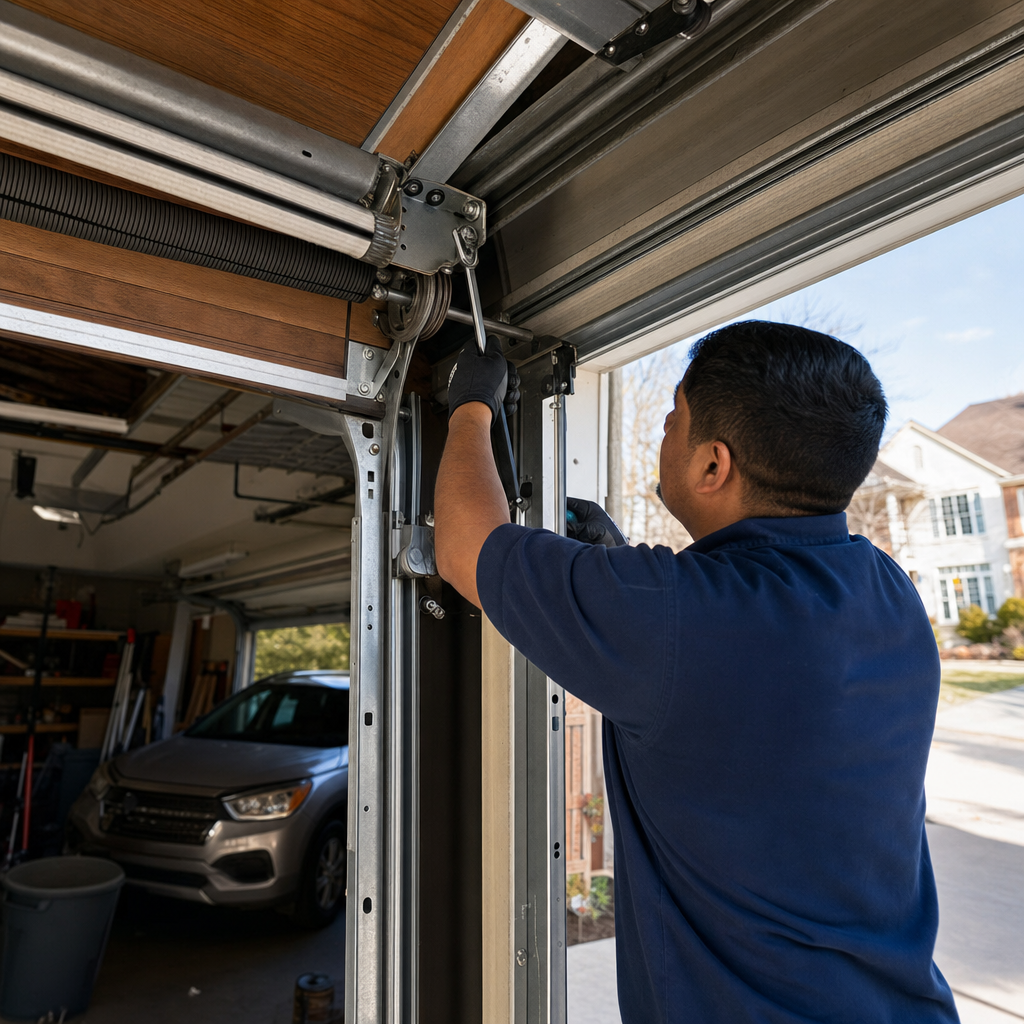
Garage Door Roller Replacement in Chicago: What It Costs and Why Chicago’s Climate Changes the Part You Need
Garage door roller replacement in Chicago typically runs $110–$220 for a standard residential door, and we can usually complete the job same-day. Call (833) 895-4082 for a free estimate — Edward handles the job himself, not a subcontracted crew. Most homeowners don’t realize the roller rated for 100,000 cycles in a manufacturer’s climate-controlled test isn’t built for what a Chicago alley garage actually delivers.
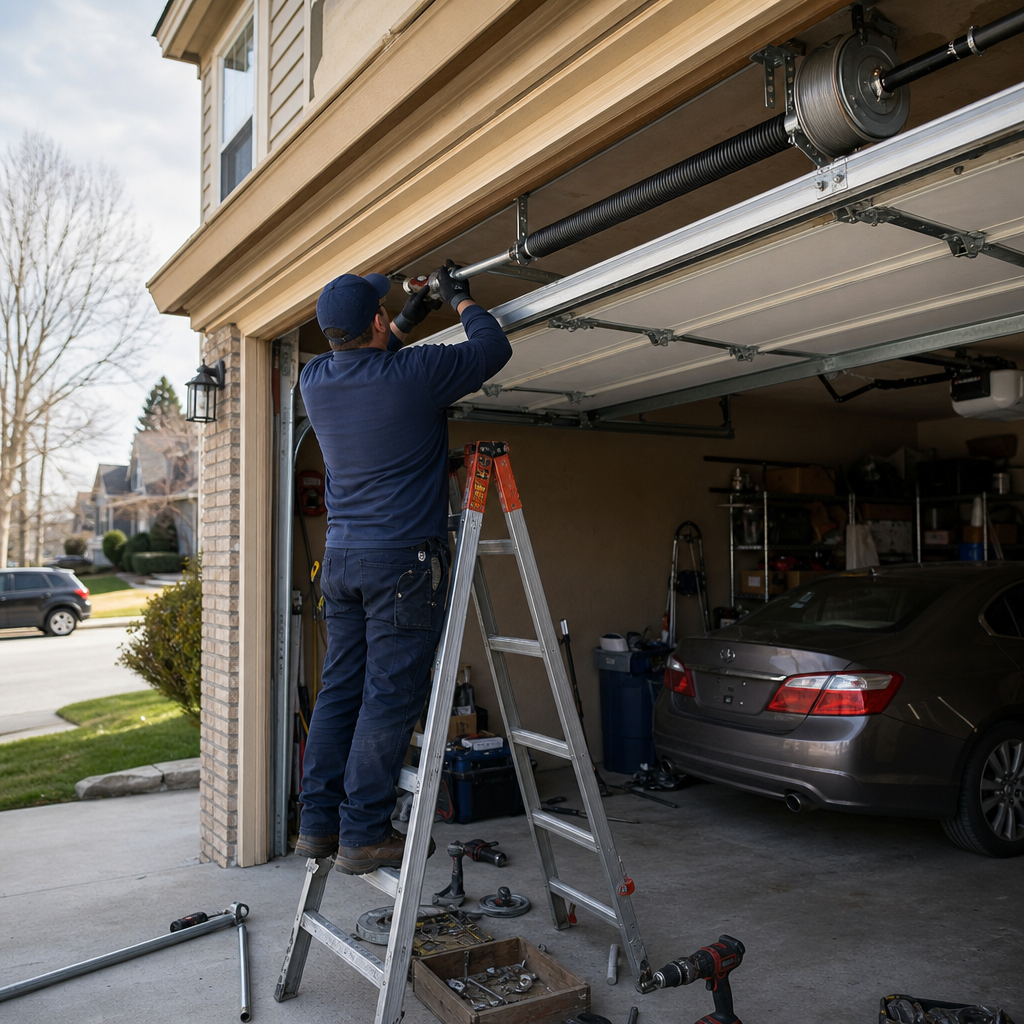
Why a “Standard” Nylon Roller Fails Faster Here Than the Box Claims
A ten-ball nylon roller rated for 100,000 cycles in a showroom is not the same thing as a ten-ball nylon roller in an unheated Chicago alley garage that hits -15°F in January. The nylon gets brittle. The bearing corrodes. The rating doesn’t account for any of that.
We’ve pulled cracked nylon rollers out of Bridgeport bungalows where the wheel material shattered like old plastic Tupperware — not from age, but from cold-cycle fatigue. Standard nylon’s flexibility window collapses below -10°F, and Chicago sees twenty to thirty nights a year that cross that threshold. When the wheel loses elasticity, it doesn’t roll; it skids, loading the bearing unevenly and chewing the stem.
Steel rollers resist the cold better, but they’re not the automatic fix. In Chicago’s alley garages, road salt residue from alley traffic gets tracked in on tires, settles into airborne dust, and coats every metal surface with chloride. We’ve seen steel roller stems corrode through in under three years in garages near busy alleys in Avondale and Jefferson Park. The rust doesn’t just seize the bearing — it swells the stem until the roller binds in the track, accelerating wear on every other component.
Our recommendation for Chicago conditions: sealed-bearing nylon rollers with a reinforced stem. The sealed bearing keeps salt and moisture out of the race. The nylon formulation in the better-grade units handles cold flex without the brittleness of economy stock. It’s not the cheapest option on the shelf, but it’s the one that matches what this city actually throws at it.
The Bungalow Track Problem Nobody’s Product Spec Mentions
In Chicago’s bungalow belt — Bridgeport, Avondale, Jefferson Park, Portage Park, and dozens of similar neighborhoods — the garage door setup isn’t what the installation manual assumes. These single-car detached garages, mostly 1920s–1940s construction, were built to 8-foot-wide openings with low header clearance. That forces a low-headroom curved track configuration: the top section of track curves back sharply so the door hugs the ceiling instead of needing twelve inches of headroom for a standard radius.
Here’s what the spec sheet won’t tell you. A standard 2-inch roller in a tight-radius top section loads asymmetrically through the curve. The ball bearings inside don’t distribute weight evenly; they pile load onto the inboard race as the roller cants through the bend. Pull a worn roller from a curved track and you’ll see the wear pattern clear as day — polished metal on one side of the race, untouched on the other. In a straight-track suburban installation, that same roller would have worn uniformly and lasted years longer.
We’ve learned to specify slightly oversized rollers or enhanced-bearing units for curved-track Chicago garages. The extra load capacity compensates for the asymmetric stress. It’s a judgment call Edward makes on-site after eyeballing the track radius — not something you can order from a parts diagram.
And then there’s the slab. Chicago’s underlying glacial clay heaves and settles asymmetrically over decades, especially in these older neighborhoods. We’ve walked into garages where the door opening is visibly out of square at the bottom by an inch or more. A technician who doesn’t shim or level the apron before adjusting tracks will keep chasing a binding door that no mechanical fix alone can solve. We’ve seen competitors replace rollers twice in two years on the same door because they never addressed the foundation geometry.
The Salt Abrasion Issue and the Ten-Minute Protocol That Doubles Roller Life
Road salt is the hidden accelerant in Chicago garage door wear. Not just on your car — in your track. Salt residue from alley traffic becomes airborne particulate, settles into the horizontal track sections, and mixes with grease and dust into a grinding paste. Every cycle, the roller stem slides through that abrasive film. Under magnification, the stem surface looks sandblasted.
When we replace rollers, we don’t just swap parts. We run a specific track cleaning protocol that takes about ten minutes and pays for itself:
- Remove all old grease and particulate with solvent — not just wipe-down, full removal
- Inspect track for pitting or corrosion, especially the lower horizontal runs where salt settles
- Apply a thin film of lithium-based lubricant to the cleaned surface — enough to protect, not enough to attract fresh grit
- Check track alignment and fastener torque, since vibration loosens lag screws over Chicago’s freeze-thaw cycles
Skipping this step is like putting new tires on a car with gravel in the wheel wells. We’ve tracked the difference: cleaned and properly lubed tracks extend roller life from roughly three years to six or more in typical Chicago alley conditions.
How Often Should You Actually Replace Rollers in Chicago?
Nationally suggested replacement cycles of 5–7 years assume moderate climate, attached garage, and standard suburban construction. Edward’s field observation across eight years in Chicago runs closer to 3–5 years for standard rollers in regular use — and that’s with a door that gets cycled once or twice daily, not the heavy use of a home business or multi-driver household.
The warning signs we look for on inspection:
- Visible cracking or chipping on nylon roller wheels
- Grinding or squealing that persists after track lubrication
- Visible rust weeping from sealed bearings (the seal has failed)
- Door shuddering or jerking in the upper curve section — asymmetric bearing wear
- Stem wobble visible when the door is manually lifted to half-height
We work on Clopay, Amarr, and Wayne Dalton doors across Chicago, and the roller wear patterns vary by door weight and track geometry — but the climate penalty is consistent across every brand. Genie openers mounted on these older doors also work harder when rollers drag, so catching wear early saves motor strain too.
What Roller Replacement Costs in Chicago — and Why Full-Set Replacement Saves Money
Here’s the pricing structure we use, calibrated to Chicago’s market and the part quality this climate demands:
| Service | Price Range |
|---|---|
| Roller Replacement (per roller) | $15–$35 (part + labor pro-rata) |
| Full Set Roller Replacement (10–12 rollers, standard door) | $110–$220 |
| Upgraded Sealed-Bearing Nylon (full set) | $160–$280 |
| Track Cleaning & Lube Protocol (with roller job) | Included |
| Track Realignment (if needed) | $120–$240 |
Replacing rollers one at a time as they fail costs more. Here’s why: every truck roll has a base cost — fuel, time, scheduling overhead. A single-roller call in February might run you $80–$100 minimum. Do that three times over two years and you’ve spent $240–$300 for piecemeal fixes. The full-set replacement at $110–$220 gets you matched wear, consistent rolling resistance, and one warranty period. Plus, when rollers wear at different rates, the door loads unevenly, stressing cables and springs asymmetrically — we’ve seen that lead to premature spring failure that costs far more than the rollers would have.
We carry Garage Door Parts for all major brands on the truck, so we’re not making a supply run while your door sits half-fixed. That’s especially critical in January when a stuck door means a car trapped outside or a garage open to the alley overnight.
When Roller Wear Is Actually a Track or Spring Problem in Disguise
Not every noisy or binding door needs rollers. We’ve diagnosed doors in Portage Park where the homeowner was convinced rollers were shot, and the real issue was a torsion spring that had lost tension and was letting the door sag into the track. The rollers were fine; they were just overloaded.
Edward’s approach: “Tell me what it’s doing and I’ll tell you exactly what’s wrong — no guessing, no upselling.” We’ll check spring balance, cable condition, and track geometry before recommending any parts. Sometimes the fix is a spring adjustment and a track cleaning, not a roller swap. We’ve walked away from jobs where the honest answer saved the homeowner money, even when it cost us a sale. That’s how you get to 365 reviews at 4.8 stars — by not treating every symptom as an opportunity to sell.
We service all eight major brands — LiftMaster, Chamberlain, Genie, Clopay, Amarr, Wayne Dalton, Craftsman, and Raynor — so whatever door you’ve got, we’ve worked on its specifics before. The hardware varies: stem diameter, wheel width, bearing type. A roller that fits a Wayne Dalton TorqueMaster setup won’t necessarily drop into a Clopay pin-mount hinge. Edward measures on-site rather than guessing from a photo.
Emergency Roller Failure: What to Do Tonight
When a roller seizes completely or the stem snaps, the door can jam mid-cycle or jump the track. That’s not a tomorrow problem in Chicago — it’s a security and weather exposure issue tonight. Our emergency garage door service is built into how we operate, not an upsell tacked onto normal hours. We’ve replaced rollers at 10 p.m. in Jefferson Park when the homeowner couldn’t get their car out for morning shift work.
If you’re stuck now: don’t force the door with the opener — you’ll strip the drive gear or worse. Disconnect the opener arm and try to lift manually. If it binds or tilts, stop. The door is out of track alignment and needs professional attention. We’ve seen homeowners turn a $180 roller job into a $500 panel replacement by forcing it.
FAQs
Garage door roller replacement in Chicago costs $110–$220 for a full set on a standard residential door, or roughly $15–$35 per roller if addressed individually. Upgraded sealed-bearing nylon rollers run $160–$280 installed. Call (833) 895-4082 for an exact quote — estimates are free, and Edward handles the job himself.
Rollers aren’t repairable — once the bearing is worn or the wheel is cracked, replacement is the only fix. However, replacing the full set at once is cheaper than addressing rollers one-by-one as they fail, since you avoid repeated service call minimums and prevent uneven wear that damages springs and cables. Call (833) 895-4082 and we’ll tell you whether your situation needs the full set or if a partial replacement makes sense.
Yes — we complete most roller replacements same-day, and emergency service is available when a seized or broken roller has jammed the door. We carry parts for all major brands on the truck, including Clopay, Amarr, Wayne Dalton, and Genie-compatible hardware. Call (833) 895-4082 to check current availability.
In Chicago’s alley garages, standard nylon rollers typically last 3–5 years with normal use — shorter than the 5–7 year national estimate because sub-zero temperatures embrittle nylon and road salt accelerates bearing corrosion. Sealed-bearing nylon rollers with proper track maintenance can double that lifespan. Call (833) 895-4082 for a free inspection and we’ll give you a straight assessment of your current rollers.
Ready to Get Your Door Rolling Smooth Again?
Don’t let a grinding, shuddering door turn into a stuck door on the coldest night of the year. Edward Campbell, Owner & Lead Technician at Regal Garage Door Repair Greater Chicago, will diagnose the real problem, replace what actually needs replacing, and leave your door running quieter than it has in years. Call (833) 895-4082 now for a free estimate — we’re here for same-day service across Chicago, and we’ll treat your garage like we’d treat our own.
Written by Edward Campbell, Owner & Lead Technician at Regal Garage Door Repair Greater Chicago, serving Chicago, IL.