
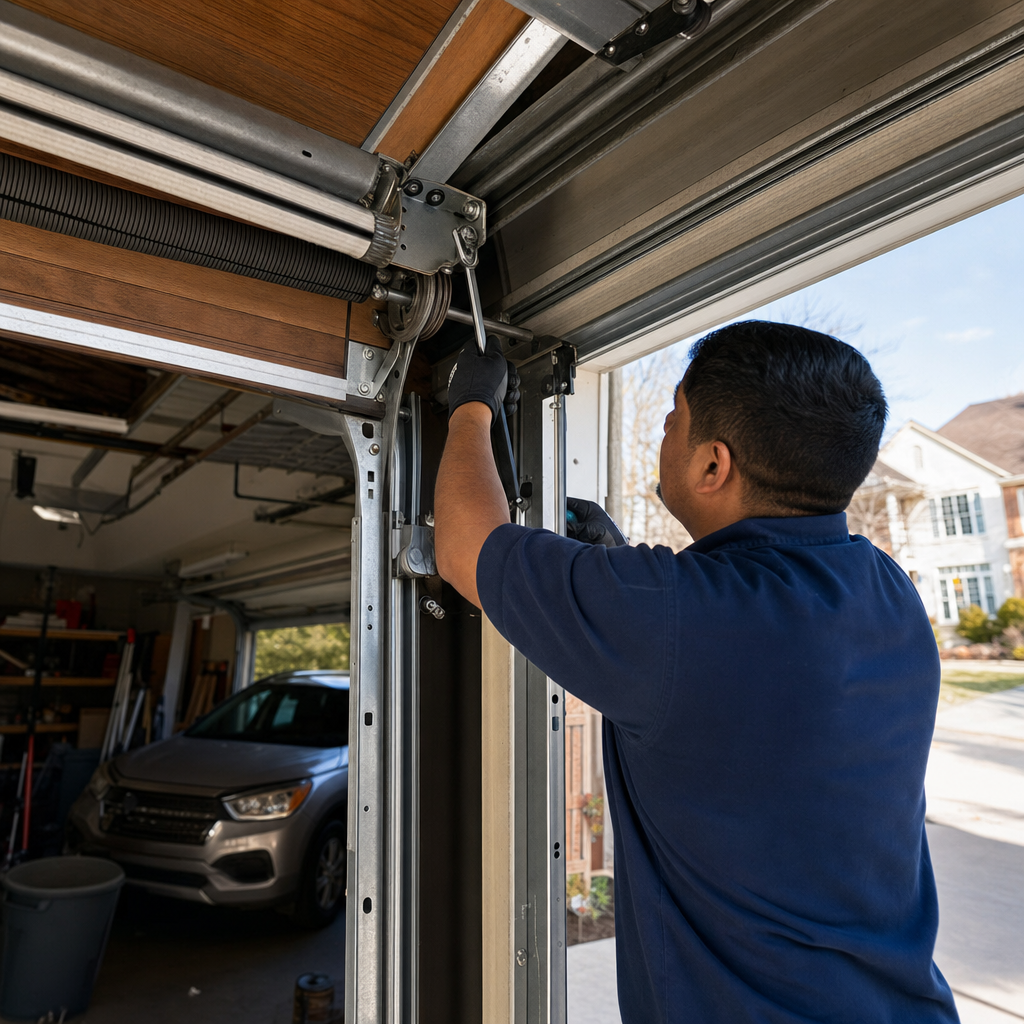
Garage Door Off Track Repair in Chicago: Why Slab Heave Is Usually the Real Culprit
A garage door off track repair in Chicago typically costs $150–$600, with most alley-garage realignments falling between $120–$240 for track work alone. If your door is binding, hanging crooked, or has completely jumped its rollers, call (833) 895-4082 — we can usually diagnose the root cause over the phone and schedule same-day service. Edward Campbell, our owner and lead technician, has handled this exact scenario hundreds of times across Chicago’s bungalow belt, and the fix is rarely as simple as “bent track.”
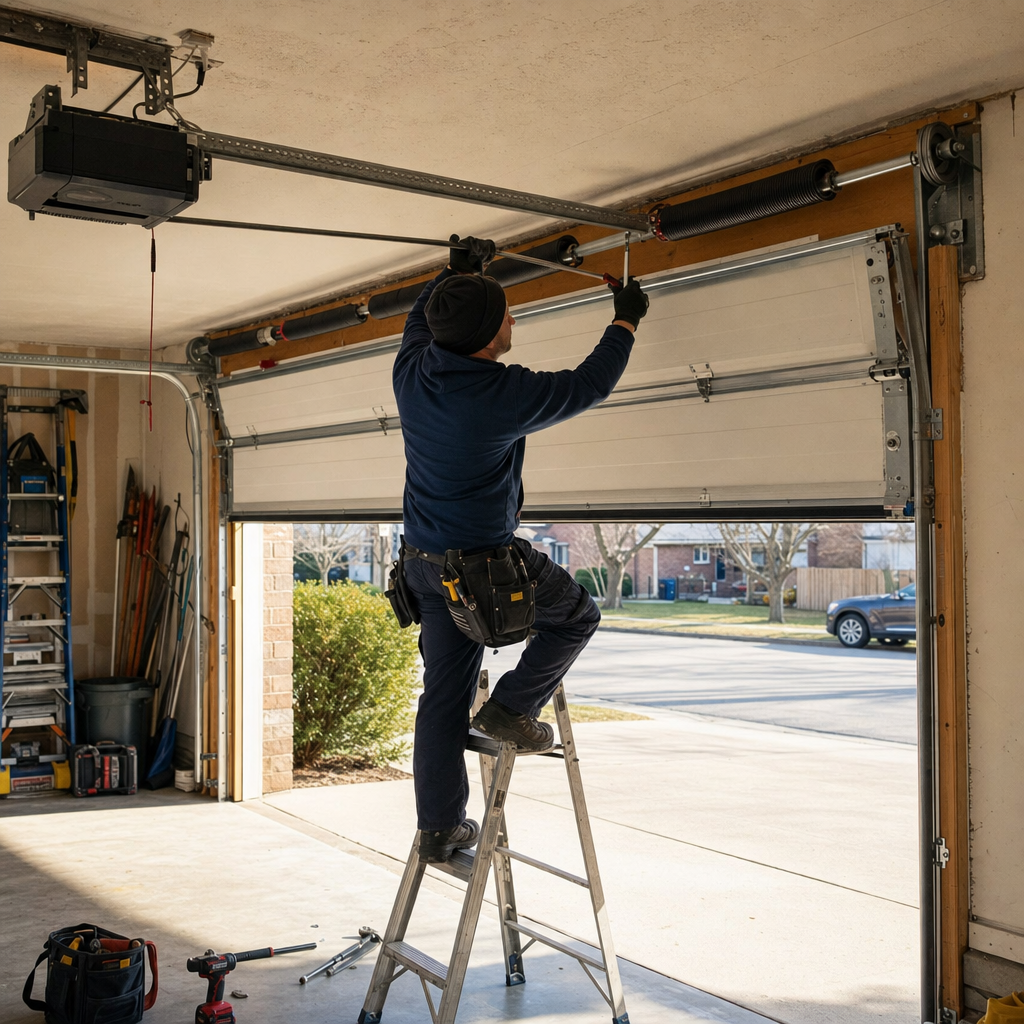
Why Chicago Alley Garages Go Off Track Differently
Here’s the thing most homeowners don’t realize until they’re staring at a stuck door at 6 a.m.: in Chicago, the ground moves. Not dramatically, not all at once, but relentlessly. The glacial clay beneath neighborhoods like Bridgeport, Avondale, and Jefferson Park expands when frozen and contracts when thawed, and it doesn’t do either evenly. Over twenty or thirty years, your garage slab can heave on one corner and settle on another, rotating the entire opening out of square.
When that happens, the vertical tracks — bolted to the jambs, which sit on the slab — tilt with the slab. The door, still manufactured as a perfect rectangle, now has to travel through a parallelogram. The rollers bind on one side, skip on the other, and eventually eject completely. You didn’t hit anything. The door didn’t fail. The geometry changed underneath it.
We see this constantly in Chicago’s alley-garage stock — those 1910s-to-1950s detached structures with 8-foot-wide openings and minimal headroom that dominate the city’s 1,900-mile alley grid. A technician who shows up, whacks the track back into “plumb” with a level, and leaves is setting you up for a repeat call in six months. The track wasn’t wrong; the slab was wrong, and the track was adjusted to match a shifting target.
How to Spot Slab Heave Before It Takes Your Door Down
Walk to the outside of your closed garage door and crouch down. Look at the gap between the bottom of the door and the concrete apron — specifically the two bottom corners. On a properly aligned door, that gap should be consistent left to right, maybe a quarter-inch at most. If one corner is tight to the ground and the other shows a half-inch or more of daylight, your slab has rotated. The jamb on the high side has lifted, tilting the vertical track inward or outward, and the door is now fighting its own path every time it moves.
In neighborhoods near the lake, we see a compounding factor: sustained east wind loads off Lake Michigan gradually rack the door panels and blow out weatherstripping first, then the panel distortion stresses the roller-to-track relationship until something gives. By the time the door actually jumps track, the failure has been building for years. The weatherstripping was the canary; the roller ejection is the cave-in.
The Three Causes, in Order of Frequency for Chicago
When Edward Campbell arrives at an off-track call, he’s already running a mental diagnostic based on what the homeowner described. Here’s how the causes actually break down in our Chicago market:
- Slab heave (roughly 60% of calls): Gradual, no single remembered incident, bottom-corner gap visible, often worse after hard freezes. The fix requires shimming or leveling the apron, then realigning tracks to the corrected geometry — not the other way around.
- Roller wear (roughly 25% of calls): Gradual, usually accompanied by grinding or squealing before failure, door may hang unevenly but still operate intermittently. Steel rollers on older Raynor and Craftsman doors in Chicago’s salt-heavy alley environment corrode faster than nylon equivalents. Replacement is straightforward once we identify the right stem length and wheel diameter for your track system.
- Impact damage (roughly 15% of calls): Sudden, homeowner knows exactly when it happened, visible panel crease or dent, often one side only. The track itself may be bent, or the horizontal/vertical junction may have spread. Sometimes panel replacement is necessary; sometimes we can straighten the track and replace rollers if the damage is localized.
The distinction matters because the repair scope changes dramatically. Slab heave without apron correction is a band-aid. Roller wear without checking for underlying track damage invites repeat failure. Impact damage without inspecting the horizontal track alignment can leave you with a door that closes but won’t seal properly against Chicago’s winter wind.
What “Shimming the Apron” Actually Means
This is where a lot of off-track repairs in Chicago go wrong, and it’s the specific Information Gain we want every homeowner to understand. When we say “shimming the apron,” we mean correcting the plane of the concrete slab where it meets the door opening so the jambs — and therefore the tracks — can be mounted plumb and true.
In practice, this usually involves one of three approaches:
- Steel or composite shims under the jamb base on the low side, bringing the vertical member back to plumb without structural concrete work. Fast, effective for minor heave (under 3/8 inch), and permanent if the slab has stabilized.
- Grinding or planing the high side of the apron where it interferes with door travel, combined with jamb adjustment. Used when the slab has lifted rather than settled, which is common on the north or shaded side of alley garages where frost penetrates deeper.
- Full apron replacement or mud-jacking referral for severe, active heave (over 3/4 inch differential). We’re honest about when this is needed — Edward has told homeowners the mechanical fix won’t hold until the concrete is addressed, even when it means deferring a paying job.
We don’t treat shimming as optional or cosmetic. On a heaved slab, it’s a precondition for a lasting repair. We’ve inherited callbacks from other Chicago garage door repair companies who skipped this step, and the homeowner paid twice for the same problem. Eight years in this market has taught us that shortcutting the foundation — literally — always costs more.
What Track Realignment Costs in Chicago
Pricing depends on root cause, door size, and whether we’re working on a standard steel door or a heavier Wayne Dalton or Clopay model with proprietary hardware. Here’s what we typically see in the Chicago market:
| Service | Price Range |
|---|---|
| Track Realignment (standard, no slab correction) | $120–$240 |
| Track Realignment with Apron Shimming | $180–$340 |
| Roller Replacement (per door, standard steel) | $110–$220 |
| Roller Replacement (heavy-duty/nylon upgrade) | $140–$280 |
| Track Section Replacement (single vertical or horizontal) | $200–$380 |
| Full Track System Replacement (both sides) | $350–$600 |
These ranges assume a standard single-car door in Chicago’s typical 8-foot-wide alley-garage opening. Wider doors, low-headroom track configurations, or proprietary systems like certain LiftMaster jackshaft setups may run higher. We quote upfront after inspection — no surprises, no pressure. Call (833) 895-4082 for a free estimate.
Safety: What to Do Right Now, and What Not to Do
If your door is off track with a functional torsion spring, you are dealing with a loaded mechanical system. The spring is still storing energy, and the door — even a “light” residential panel — can weigh 150 to 250 pounds. Here’s the sequence we want every Chicago homeowner to follow:
- Disengage the opener using the red emergency release cord. Pull it straight down, not toward you, to avoid damaging the carriage.
- Do not try to force the door open or closed. A door out of its tracks can drop suddenly if rollers slip further, and fingers or worse can end up in the wrong place.
- Secure the door if it’s partially open — prop it with a sturdy ladder or locking pliers on the track below a roller that is still engaged, but understand this is temporary stabilization, not a fix.
- Assess, don’t repair. Look for the bottom-corner gap we described, listen for grinding, note any visible panel damage — then call a trained professional.
We do not recommend DIY track realignment. The adjustment itself isn’t conceptually difficult, but evaluating whether the root cause is slab heave, roller wear, or impact damage requires experience — and getting it wrong can mean a door that fails catastrophically the next time it’s operated. Edward handles these calls personally, and he’s seen the aftermath of well-intentioned homeowner fixes that turned a $180 adjustment into a $600 full-track replacement.
Common Local Scenarios We’ve Handled
The Bridgeport bungalow, February 2023: Customer called with a door that had worked fine for twenty years, then started binding after a week of sub-zero overnight lows. Bottom corner gap was 5/8 inch on the north side. We shimmed the jamb, realigned the track to the corrected plane, and replaced corroded steel rollers with sealed nylon units. Door has operated silently through two winters since.
The Avondale two-flat, summer 2024: New homeowner didn’t know the previous owner had backed into the door three years prior. Visible crease in the second panel, but the real issue was a spread horizontal-to-vertical track junction that let the top roller walk out under wind load. We replaced the damaged track section, re-secured the junction bracket, and showed the customer how to check for future spread. “Tell me what it’s doing and I’ll tell you exactly what’s wrong — no guessing, no upselling.”
The Jefferson Park alley garage, January 2025: Classic slab heave compounded by lake-effect moisture corrosion. The galvanized track had thinned at the lower mounting points, and the heave stress finally pulled the bolts through. Required track replacement plus apron shimming plus upgraded fasteners into the corrected jamb. Three distinct problems, one root cause, one permanent fix.
Why Brand Familiarity Matters for Off-Track Repairs
Chicago’s housing stock is old enough that we encounter virtually every major garage door and opener brand still in service. When Edward Campbell shows up to an off-track call, he’s not guessing whether your Craftsman door uses standard 2-inch rollers or the older 1-3/4-inch stem, or whether your Wayne Dalton TorqueMaster system requires special handling before track work can proceed safely. We work on LiftMaster, Chamberlain, Genie, Clopay, Amarr, Wayne Dalton, Craftsman, and Raynor — and that familiarity means faster diagnosis, correct parts on the first visit, and no “let me check the warehouse” delays.
Our garage door repair in Chicago service is built around this competency. An owner-operator who knows the equipment, knows the local conditions, and has 365 verified reviews averaging 4.8 stars to back up the claim. When your door won’t move at 10 p.m., you’re not getting a subcontractor who needs to call a dispatcher for advice. You’re getting Edward.
FAQs
Most garage door off track repairs in Chicago run $150–$600, with simple track realignments at $120–$240 and more involved jobs requiring slab correction or track replacement toward the higher end. We provide exact quotes after inspection — call (833) 895-4082 for a free estimate.
Yes — we offer same-day service for off-track doors across the Greater Chicago area, including emergency calls when the door is stuck open or insecure. Edward Campbell carries the common track hardware, rollers, and shimming materials needed for most repairs on his service vehicle.
Repair is almost always cheaper for an off-track door — replacement only makes sense if the panels are severely damaged, the track system is obsolete, or the door is nearing end of life anyway. We’ll tell you honestly if replacement is the better value; 8 years, one standard.
Recurring off-track problems usually mean the root cause wasn’t addressed — most commonly slab heave in Chicago’s clay-soil neighborhoods, where the ground shifts seasonally and pulls the track mounting points out of alignment. Shimming or leveling the apron before track adjustment is essential for a permanent fix.
Get Your Door Back on Track — Permanently
A garage door off track is stressful, but it doesn’t have to stay that way. Whether you’re dealing with gradual slab heave in a Bridgeport bungalow, wind-racked panels in a lakefront alley garage, or straightforward roller wear on a Craftsman door you’ve had for years, we’ll diagnose the real problem and fix it right. Edward Campbell, owner and lead technician at Regal Garage Door Repair Greater Chicago, handles every job personally — no subcontractors, no guesswork, no upselling.
Call (833) 895-4082 now for a free estimate and same-day service anywhere in Chicago. We’ll get your door moving smoothly again, and we’ll make sure it stays that way.
Written by Edward Campbell, Owner & Lead Technician at Regal Garage Door Repair Greater Chicago, serving Chicago, IL.