
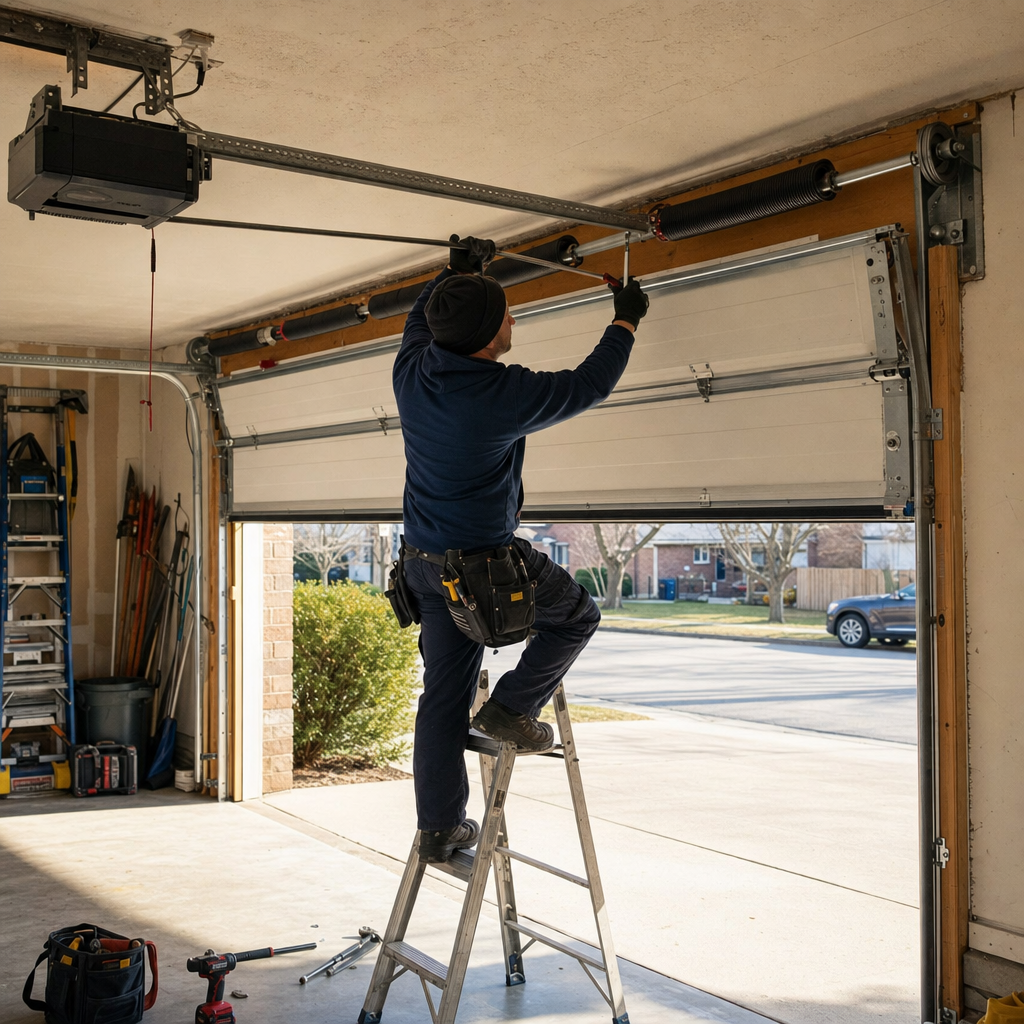
Why Chicago Homeowners Choose LiftMaster Garage Door
We provide independent LiftMaster garage door service across Chicago, from Edison Park to South Shore, with same-day repairs starting at $120 and full opener installations from $250 to $550. Edward Campbell, our owner and lead technician, personally handles every LiftMaster call — eight years in the trade, 365 verified reviews at 4.8 stars, and no subcontracted crews. We’re not affiliated with or authorized by LiftMaster; we’re an independent service provider who knows these openers inside and out because we’ve repaired and installed hundreds of them in Chicago’s alleys, basements, and coach houses.
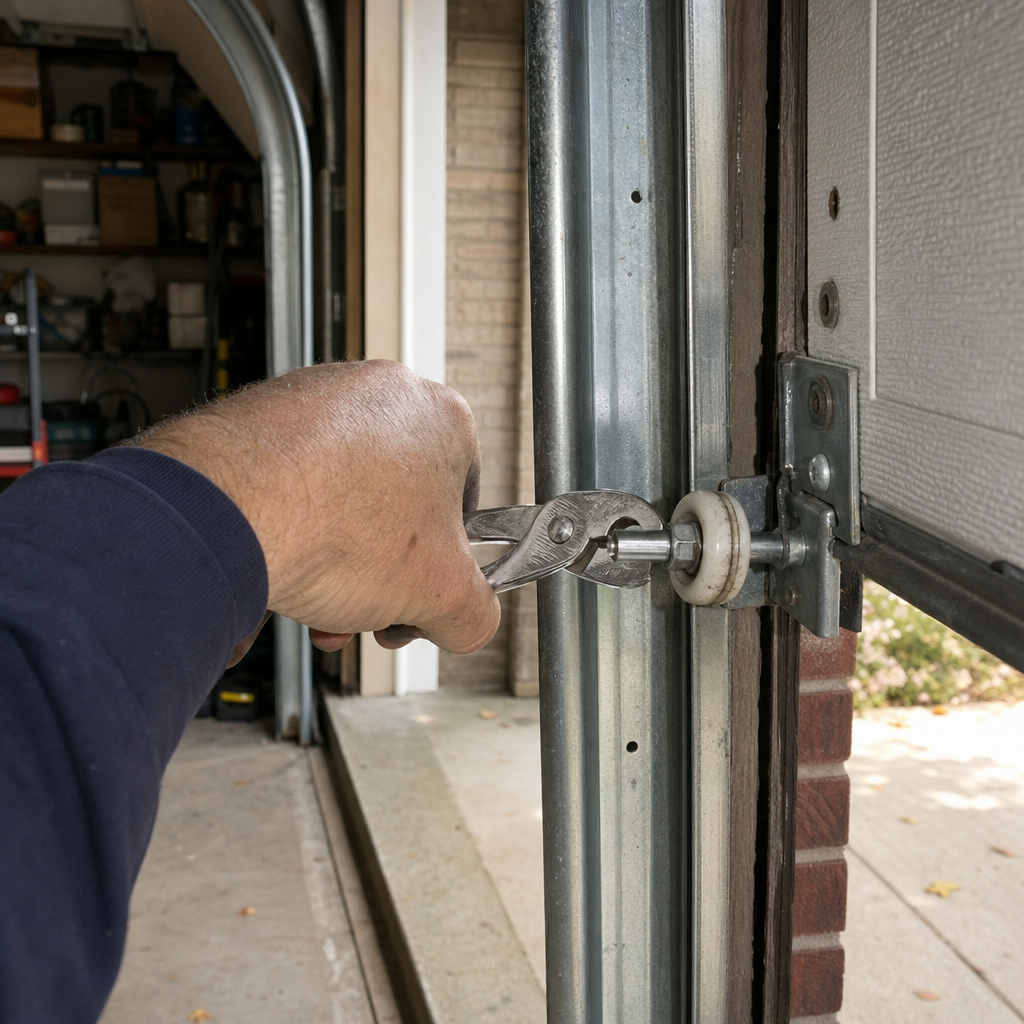
LiftMaster dominates the Chicago market for good reason. The brand’s AC-chain-drive workhorses — the Contractor Series 8160WB and the ever-reliable 8365W — hold up better than most against our freeze-thaw cycles and salt-laden alley slush. The wall-mounted 8500W and newer 8500W-267 jackshaft models have become popular in bungalow belt neighborhoods like Jefferson Park and Avondale, where low headroom in 1920s garages makes standard trolley openers impossible. We’ve also seen steady adoption of the myQ-enabled 87504-267 and the battery-backup 87504-267 in newer construction and gut-rehabbed two-flats where smart-home integration matters.
Chicago’s roughly 1,900 miles of rear alley lanes mean nearly every garage door we service opens onto an alley, not a driveway. These detached structures — mostly 1910s to 1950s construction — present challenges no suburban LiftMaster installer faces: 8-foot-wide openings (not the modern 9-foot standard), unlevel concrete aprons heaved by glacial clay, and minimal headroom that forces creative opener placement. We’ve mounted 8500W jackshafts on jambs so tight we had to fabricate custom brackets. We’ve shimmed 8365W trolley rails across sagging headers in Bridgeport brick garages where the original 1920s timber has bowed three inches. This is the work that separates a technician who’s read the manual from one who’s pulled a snapped torsion spring at 7 a.m. on a February morning and lived to tell the story.
Why Trust Regal Garage Door Repair Greater Chicago for Your LiftMaster Garage Door?
Edward Campbell grew up on the Northwest Side, not far from Portage Park, where he spent weekends helping his father maintain the family’s two-flat. He picked up hands-on mechanical training at Triton College in River Grove — electrical systems, mechanical repair, the kind of foundation that lets you read a wiring diagram and actually understand what the current is doing. Eight years running Regal Garage Door Repair, he’s built a reputation for honest diagnostics: he’ll tell you when a $140 gear-and-sprocket kit saves your 8365W and when the opener’s circuit board is corroded beyond reliable repair.
We carry LiftMaster-compatible parts that match OEM specifications — gear assemblies, logic boards, safety sensors, force adjustment modules, rail extensions for 8-foot doors common in Chicago’s older housing stock. We don’t guess at compatibility. We cross-reference model numbers against LiftMaster’s service bulletins and our own field notes. When your 8160WB starts clicking without lifting, we know the motor capacitor failure pattern that series exhibits after six to eight Chicago winters. When your myQ app loses connection on a 87504-267, we’ve already checked whether the Wi-Fi module firmware needs updating before we quote you a new board.
Our warranty-safe practices matter. We document serial numbers, use manufacturer-specified torque settings on rail hardware, and never bypass safety sensors — the kind of shortcut that voids coverage and puts your family at risk. Edward handles the job himself. “Tell me what it’s doing and I’ll tell you exactly what’s wrong — no guessing, no upselling.” That’s the standard we’ve held for 365 customer reviews across eight years.
Common LiftMaster Garage Door Problems We Fix in Chicago
- 8160WB / 8365W chain-drive opener — motor runs, door doesn’t move. The nylon gear inside the gear-and-sprocket assembly strips its teeth after years of lifting heavy Chicago wooden doors through frozen bottom seals. We see this most in January and February when the door sticks to the ground and the opener strains against the ice bond. The motor hums, the chain doesn’t budge, and the plastic gear has turned to shavings. We replace with a steel-reinforced compatible gear kit, not the same weak nylon, and we always check whether the door’s rollers and tracks need attention so it doesn’t happen again next winter.
- 8500W / 8500W-267 jackshaft — excessive force errors or reversed travel limits. These wall-mounted units depend on precise cable tension and drum positioning. In Chicago’s alley garages, where doors get racked by lake-effect wind loads and slabs settle unevenly, the jackshaft’s force-learning algorithm can miscalibrate. The opener thinks it’s hitting an obstruction and reverses, or it doesn’t fully close and your garage is open all night in Back of the Yards. We relearn force settings after correcting the underlying mechanical issue — track alignment, spring tension, or apron leveling — because recalibrating alone just masks the real problem.
- 87504-267 / myQ-enabled models — Wi-Fi and app connectivity failures. The myQ hub in these units is sensitive to Chicago’s older electrical infrastructure: voltage drops on 1920s two-flat service panels, aluminum wiring in postwar bungalows, and interference from neighboring 2.4 GHz networks in dense neighborhoods like Logan Square. We test signal strength at the opener location, check for proper grounding, and update firmware when available. Sometimes the fix is a $35 Wi-Fi range extender; sometimes it’s a failing logic board. We find out before we quote.
- Safety sensor misalignment — constant flashing light, door won’t close with remote. LiftMaster’s amber-and-green sensor pair gets knocked out of alignment by alley garbage carts, snowplow slush, and the general abuse of Chicago’s tight rear lanes. But we also see failed emitter diodes from moisture intrusion after freeze-thaw cracks the housing. We don’t just realign and leave — we test the receiver’s voltage response and replace the pair if the signal is weak, because a sensor that “mostly works” in August fails completely when January darkness hits.
- Trolley carriage jam or rail deformation — grinding noise, jerky travel. The 8365W and 8164W trolley assemblies can develop flat spots on their internal rollers, especially on doors with bent tracks or worn rollers that force lateral loading. In Chicago, this compounds with rail sag from improperly secured ceiling mounts in plaster-and-lath garages where finding solid structure is half the battle. We inspect the entire travel path, reinforce mounting points with proper lag shields into masonry or joist blocking, and replace the trolley when the wear pattern warrants it — not the whole rail assembly some shops push.
LiftMaster Parts & Our Repair-vs-Replace Approach
We stock LiftMaster-compatible parts that meet or exceed OEM specifications: gear and sprocket kits, motor capacitors, logic boards for 2013–present models, safety sensor pairs, trolley carriages, rail extensions cut to 8-foot and 10-foot lengths, and battery backup units for the 8500W-267 and 87504-267 series. Genuine LiftMaster OEM parts are available when specifically requested, but our compatible components carry equivalent warranties and often outperform original nylon gears in Chicago’s cold-start conditions.
Our repair-vs-replace decision is straightforward. A 2016 8365W with a stripped gear and otherwise clean board? $140–$180 repair, five-year life extension. A 2008 3240 with a seized motor, obsolete radio frequency, and no safety reverse? We show you the math: three service calls over two years versus a new 8160WB with myQ and battery backup. Edward has walked away from jobs where the honest answer was “this opener has two years left, don’t spend $400 on it.” That costs us a sale. It earns us the next call when that customer moves or their neighbor’s door fails.
Same-day parts availability means most LiftMaster repairs in Chicago finish in one visit. Call (833) 895-4082 — we’ll confirm your model and symptom by phone and bring what’s needed.
Our LiftMaster Service Process — Step by Step
- 1
Diagnosis with model-specific knowledge. We start with your model number and symptom, but we don’t stop there. Edward tests force settings, inspects safety sensor voltage, and checks the door’s mechanical balance independent of the opener. A LiftMaster that “just stopped working” often has a spring that’s been broken for weeks, overworking the motor until the thermal cutoff trips.
- 2
Repair or installation with Chicago-specific adaptations. For installs, we measure rough opening, headroom, and apron level — critical in Chicago’s non-standard garages. We shim tracks to compensate for settled slabs in bungalow-belt neighborhoods, use rail extensions sized to actual opening width (not assumed 9-foot), and mount jackshafts with custom brackets when original jambs are out of plumb.
- 3
Full-cycle testing under load. We run the door through twenty complete cycles, testing force reversal with a 2×4 block per UL 325, verifying photo-eye response with opaque and translucent obstructions, and confirming myQ pairing where applicable. We test battery backup operation on equipped models — not just that the light works, but that the door completes a full cycle on battery power.
- 4
Warranty documentation and homeowner walkthrough. We record serial numbers, document parts used, and explain maintenance specifics for your model: chain lubrication intervals for 8160WB units, battery replacement timing for 8500W-267 systems, and what to watch for as your door ages in Chicago’s climate.
LiftMaster Products We Service & Install in Chicago
We work on every LiftMaster residential line currently in Chicago homes: the Contractor Series chain-drive 8160WB and 8164W; the premium belt-drive 8355W and 8550W; the wall-mounted jackshaft 8500W, 8500W-267, and Elite 8500; the myQ-integrated 87504-267 and 87802; and legacy models including the 3240, 3280, and 3585 that still run in prewar two-flats and mid-century ranches. We stock rail kits for 7-foot, 8-foot, and 10-foot doors — the 8-foot inventory matters here, since Chicago’s original garages were built for Model A Fords, not modern SUVs. For new installations, we recommend the 8160WB for value, the 8500W-267 for low-headroom applications, and the 87504-267 for homeowners who want smart integration with battery backup.
We Also Service These Brands
LiftMaster is our most frequent call, but we’re equally familiar with Chamberlain — LiftMaster’s consumer-line sibling, sharing rail systems and logic boards — and Genie, with its screw-drive and chain-drive models common in 1990s Chicago construction. We also work on Clopay, Amarr, Wayne Dalton, Craftsman, and Raynor door and opener systems. One technician, eight brands, no “we’ll have to call someone else.”
FAQs — LiftMaster Garage Door Service in Chicago
Is Regal Garage Door Repair Greater Chicago authorized by LiftMaster? No. We are an independent LiftMaster service provider with no affiliation or authorization from LiftMaster or its parent company. We service these openers based on hands-on experience, factory service documentation, and eight years of field repairs across Chicago — not through a dealer program.
Do you use genuine LiftMaster/OEM parts? We stock quality LiftMaster-compatible parts that match OEM specifications, with equivalent or better performance in Chicago’s climate. Genuine LiftMaster OEM parts are available by request. We warranty all parts and labor, and we document everything for your records.
How long does LiftMaster service take? Most repairs take 60–90 minutes on-site. Standard opener installations run 2–3 hours, longer in Chicago’s older garages where custom rail cutting, header reinforcement, or apron leveling is needed. We carry common parts and aim for same-day completion. Call (833) 895-4082 — we’ll estimate timing when you describe your model and symptom.
What LiftMaster models/series do you cover? All current residential models: 8160WB, 8164W, 8355W, 8550W, 8500W, 8500W-267, 87504-267, 87802, and legacy units back to the 3240/3280 series. If you have a commercial-duty LiftMaster or an unusual configuration, call us with the model number — we’ve handled jackshaft conversions, vertical-lift adaptations, and custom rail jobs that aren’t in the standard catalog.
Will service void my LiftMaster warranty? Independent service does not automatically void a manufacturer’s warranty, but coverage depends on the opener’s age, original purchase documentation, and whether the issue stems from a manufacturing defect or wear. We use warranty-safe practices — proper torque settings, no safety bypasses, documented serial numbers — and we’ll advise honestly if your repair likely falls under factory coverage versus out-of-warranty wear.
How much does LiftMaster garage door service cost in Chicago? Opener repairs run $120–$320 depending on parts; full opener installation is $250–$550; spring repair (often needed alongside opener work) is $180–$340. Every quote is itemized before work begins. Call (833) 895-4082 for a free estimate — we’ll ask your model number and symptom, and you’ll know the range before we dispatch.
Book Your LiftMaster Service in Chicago, IL
Edward Campbell handles every LiftMaster call personally — diagnosis, repair, installation, and the conversation about whether your 12-year-old opener deserves another fix. Eight years, one standard: honest answers, done-right work, no subcontracted surprises. For same-day LiftMaster service anywhere in Chicago, call Regal Garage Door Repair Greater Chicago at (833) 895-4082. Free estimates. Real technician on the line.
Written by Edward Campbell, Owner at Regal Garage Door Repair Greater Chicago, serving Chicago since 2016.