
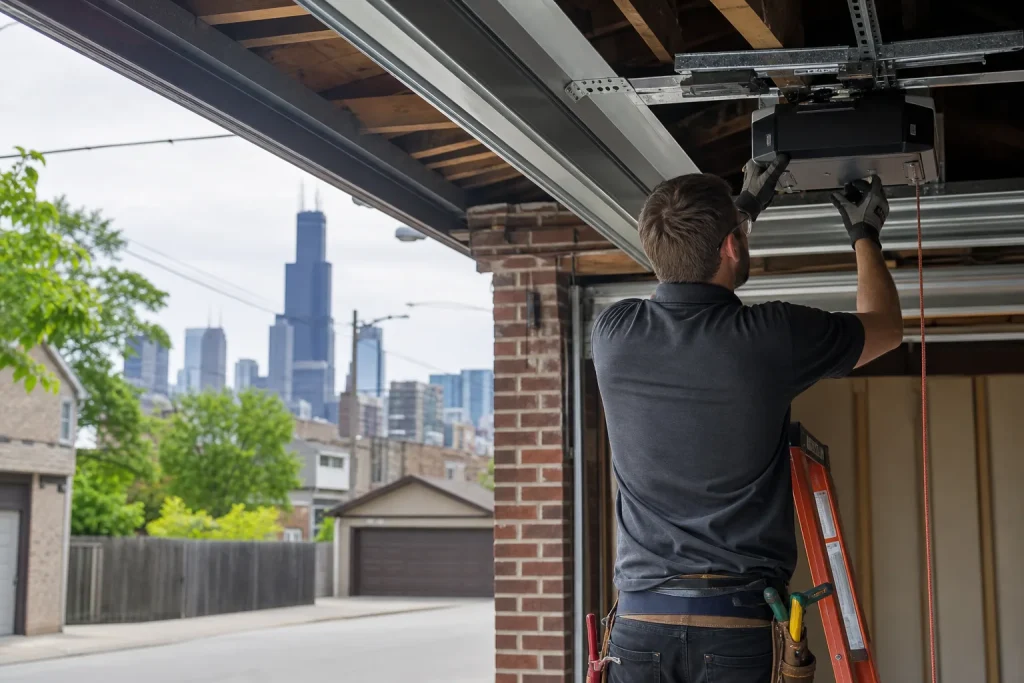
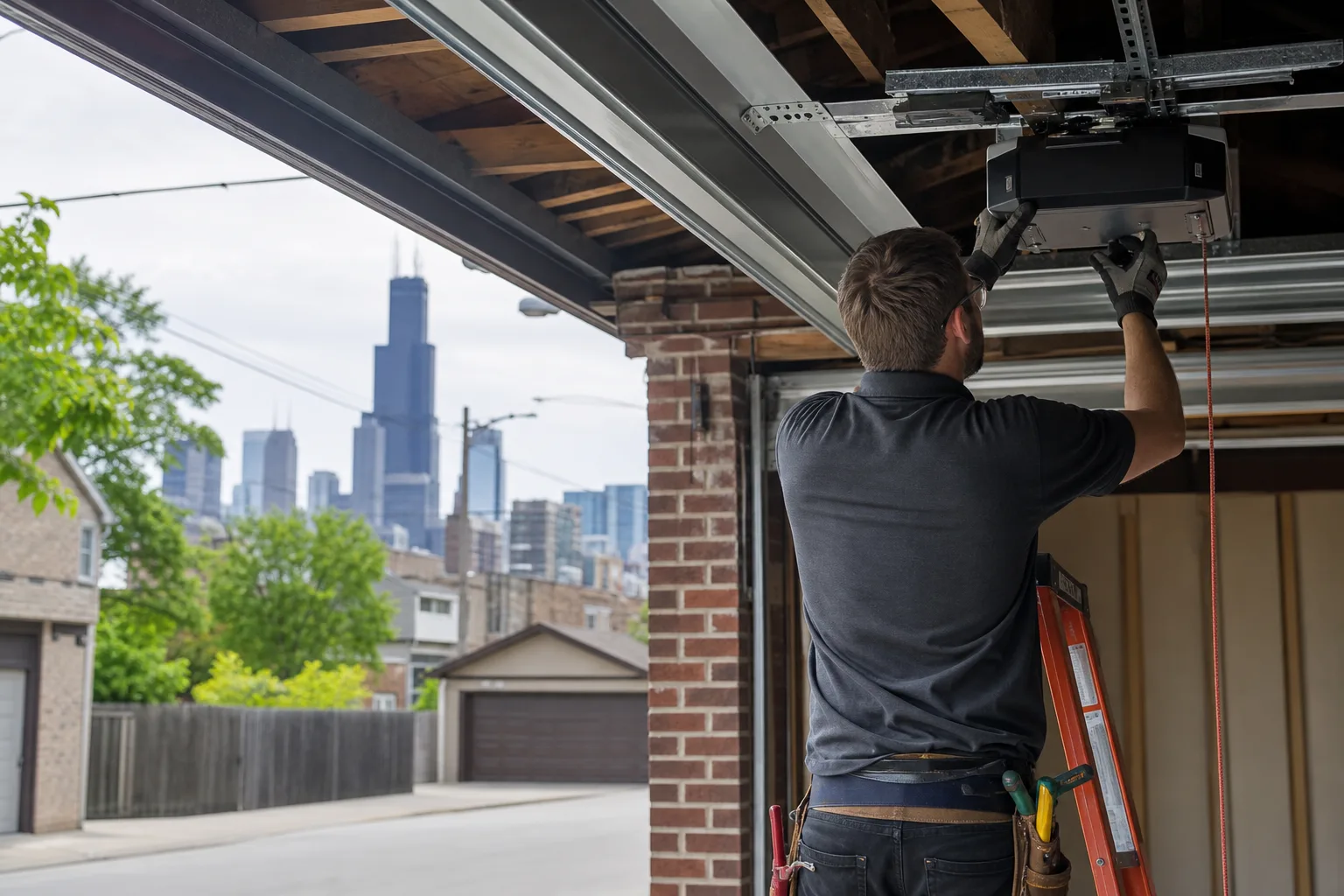
LiftMaster Garage Door Repair in Chicago: A Homeowner’s Guide
LiftMaster garage door repair in Chicago typically costs $150–$400 depending on whether you’re dealing with a sensor realignment, gear replacement, or logic board failure. Most common issues—misaligned safety sensors, worn drive gears, or MyQ connectivity drops—can be diagnosed in under 20 minutes by a technician who knows the specific model line. If your opener is making noise but not moving, or the lights flash but the door won’t close, you’re likely looking at a repairable problem rather than a full replacement. If you’d rather not troubleshoot this yourself, call us at (833) 895-4082 for a free estimate.
Here’s the thing about LiftMaster in Chicago: it’s everywhere. Walk down any block in Lincoln Park, pull into an alley in Bridgeport, or check the garage of a bungalow in Portage Park, and odds are you’ll find a LiftMaster opener mounted to the ceiling. That ubiquity is a double-edged sword. Because we see so many of them, some technicians start treating every call like it’s the same failure they’ve fixed a hundred times. In our experience, that’s how a $0 firmware reset turns into an unnecessary $200 logic board swap—or how a simple sensor bracket adjustment gets misdiagnosed as a dead motor.
We’ve been working on LiftMaster openers across Chicago for eight years, and the pattern is clear: the most expensive repairs are usually the ones that started with a wrong guess.
Which LiftMaster Models We See Most in Chicago Homes
Not all LiftMaster openers age the same way, and knowing your model number before you call can save both time and money. In Chicago’s housing stock—heavy on 1920s bungalows, mid-century ranches, and newer infill construction—we see three lines dominating the market:
- LiftMaster 8500W (Wall-Mount/Jackshaft): Popular in garages with limited headroom or where homeowners want the ceiling clear for storage. The failure pattern we see most? The DC motor cable drum wears unevenly when Chicago’s humidity swings hit the torsion spring system it’s paired with. Also, because this model relies on a direct connection to the torsion tube, any spring issue gets misread as an opener problem.
- LiftMaster 8165W (Chain Drive): The workhorse of older Chicago homes. The chain itself rarely fails; it’s the nylon gear inside the motor housing that strips after 8–12 years of cold-start cycles. We’ve replaced dozens of these gears in Jefferson Park and Albany Park alone. A gear kit runs about $85 in parts plus labor—far less than a new opener.
- LiftMaster 84501R (Belt Drive with Built-In Camera): Newer installs, especially in Lincoln Park and West Loop renovations. The belt is quiet but the integrated camera and LED lighting add complexity. We’ve seen camera connectivity issues present as complete opener failures when it’s actually just a Wi-Fi handshake problem between the MyQ app and the home router.
One detail competitors rarely mention: the 8500W’s manual release handle sits lower than most homeowners expect. In a city where garage ceilings are often just seven feet, we’ve had calls from Bucktown and Wicker Park where someone bumped the release cord with a kayak or bike rack, then assumed the opener was broken. Five-second fix, no parts needed.
The MyQ Diagnostic Every Chicago Homeowner Should Try First
Five years ago, a LiftMaster that wouldn’t respond meant one of three things: dead remote, tripped GFI, or failed logic board. Today, with MyQ-enabled openers, there’s a fourth category that behaves identically but costs nothing to fix: connectivity failure.
Here’s the diagnostic we walk homeowners through before we dispatch:
- Check the LED on the opener itself. Solid blue or purple means it’s connected to Wi-Fi. Flashing or dark means it’s lost the network.
- Open the MyQ app and look for “Device Offline.” If you see this, the opener’s logic board is likely fine—it’s a network issue.
- Power-cycle the opener (unplug 30 seconds, plug back in) and force-close the MyQ app completely.
- Reconnect through the app using the “Add New Device” flow, not just refreshing the home screen.
We had a call last month in Old Town where a homeowner was quoted $280 for a logic board replacement by another company. Edward walked them through this sequence over the phone. The opener reconnected in four minutes. Total cost: $0.
That said, if the opener’s LED shows normal connectivity but the door still won’t respond to the wall button or remote, you’re likely looking at an actual hardware failure. The MyQ diagnostic is a filter, not a cure-all.
How Chicago’s Climate and Garage Layout Change Sensor Problems
LiftMaster’s safety sensors—the infrared eyes near the floor on each side of the door—are the single most misdiagnosed component we encounter. Here’s what the generic repair guides don’t tell you about Chicago specifically.
Detached alley garages versus attached front-facing garages: In neighborhoods like Hyde Park, Bronzeville, and parts of Logan Square, many homes have garages accessed from the alley. These spaces freeze harder, heat faster, and see more rodent activity than attached garages. The sensor brackets expand and contract with temperature swings, and we’ve found brackets in alley garages go out of alignment twice as often as front-facing setups. The diagnostic clue: if your door closes fine at 10 a.m. but flashes and reverses at 6 p.m., thermal shift is the likely culprit.
Chicago’s temperature swings: A January day that starts at 8°F and hits 35°F by afternoon creates enough bracket movement to break the infrared beam. We use heavier-gauge brackets on repairs in Chicago Lawn and Englewood specifically because the standard LiftMaster hardware doesn’t hold up to the freeze-thaw cycle as well.
The “sunlight false positive”: West-facing garages in neighborhoods like Austin and Belmont Cragin get direct afternoon sun that can blind the receiver sensor. LiftMaster addressed this in newer models, but pre-2018 units often need a shield or sensor repositioning. We’ve seen homeowners replace entire opener systems when a $12 sun shield would have solved it.
When to call a pro: If you’ve cleaned the lenses, checked for obstructions, and the problem persists across different times of day, the issue is likely wiring degradation or bracket fatigue that needs hands-on diagnosis. Sensor wiring in Chicago garages often runs through concrete or along damp foundation walls—corrosion is common after 5–7 years.
Related services in Chicago: If your sensors keep failing because the door itself is binding or off-track, the root problem may be mechanical. We handle full garage door repair in Chicago Lawn and surrounding neighborhoods, including track realignment and spring service.
What LiftMaster’s Warranty Actually Covers (And What Voids It)
LiftMaster’s residential warranty sounds straightforward until you need to use it. Here’s the breakdown we explain to homeowners who are deciding between a warranty claim and a paid repair:
- Motor: Lifetime on most residential belt and chain drive models. But “lifetime” means the original purchaser’s lifetime, and LiftMaster requires proof of purchase with the original homeowner’s name.
- Logic board / Wi-Fi module: 5 years on current models, 1 year on some older units. This is where most “my opener died” claims land.
- Accessories (remotes, keypads, cameras): 1 year. The camera on the 84501R? That’s an accessory, not part of the motor warranty.
- Labor: Not covered. Ever. Even for warranty parts, you’ll pay for the service call and installation.
What voids the warranty: Using non-LiftMaster parts for prior repairs, including aftermarket remotes or universal receivers. We’ve seen warranty claims denied because a previous technician installed a generic safety sensor after a squirrel chewed the original. The homeowner had no idea. Also, any opener that shows signs of water damage or impact—common in Chicago garages with roof leaks or where the garage doubles as workshop space—is typically excluded.
Here’s our honest take: if your opener is under 5 years old and the motor hums but doesn’t move, a warranty motor replacement through LiftMaster’s service network might make sense. But the labor cost and scheduling delay often erase the savings. For a 10-year-old unit, warranty coverage is almost certainly expired anyway.
Repair or Replace? The Honest Math on Older LiftMaster Openers
This is where eight years of seeing the same decisions play out helps. There’s a point where repairing a LiftMaster opener is technically possible but financially unwise. The threshold depends on three factors: age, parts availability, and what safety features you’re giving up.
The 10-year rule: A LiftMaster 8165W from 2014 with a stripped gear? Repair it. The gear kit is $85, labor is straightforward, and the mechanical platform is solid. A 2008 LiftMaster with a seized motor and obsolete logic board? Replacement makes more sense. The parts are scarce, and even if you source them, you’re investing $300+ in a system without battery backup, Wi-Fi, or the automatic force-sensing that current models use to prevent entrapment.
Labor cost reality: In Chicago, a typical opener repair runs $180–$340 in labor plus parts. A new LiftMaster 84501R installed runs $550–$750 depending on bracket modifications needed. When repair labor alone approaches 60% of replacement cost, we flag it for homeowners. Edward has talked more than a few people out of repairs that would have been profitable for us but wrong for their situation.
Safety feature gap: Pre-2018 LiftMaster openers lack the Protector System auto-reverse sensitivity that current models have. If you have small children or pets, or if your garage door is the primary home entry point, the safety upgrade alone can justify replacement on a 12+ year unit.
We install and repair, so we have no incentive to push one direction. What we won’t do is quote a $400 repair on a unit that’s one failure away from the same conversation six months later.
If you’re considering a full upgrade, we handle garage door opener installation in Chicago Lawn and across the city, including smart-home integration and battery backup systems.
The Bottom Line
LiftMaster dominates Chicago’s garage door market for good reason—the openers are reliable, parts are available, and the feature set keeps pace with what homeowners want. But that popularity breeds lazy diagnostics. The most common models in Chicago homes—the 8500W, 8165W, and 84501R—each have distinct failure patterns that a technician should verify rather than assume. MyQ connectivity issues, sensor alignment problems worsened by Chicago’s climate swings, and warranty coverage gaps are all areas where homeowners lose money to wrong guesses.
Our approach at Regal Garage Door Repair Greater Chicago is straightforward: Edward Campbell handles the diagnostic himself, confirms the actual failure before quoting parts, and tells you honestly when replacement beats repair. Eight years and 365 customer reviews later, that consistency is the only marketing we need.
If your LiftMaster opener is acting up—whether it’s a grinding chain drive in Portage Park, a disconnected MyQ app in the West Loop, or sensors that only fail when the temperature drops—call (833) 895-4082 for a free estimate. We’ll give you the actual problem, the actual fix, and the actual price before any work starts.
Frequently Asked Questions
Most LiftMaster repairs in Chicago fall between $150 and $400. Sensor realignment or bracket tightening typically runs $150–$200. Gear or sprocket replacement is $200–$300. Logic board replacement ranges from $280–$400 depending on the model and whether programming is needed. Call (833) 895-4082 for an exact quote—estimates are free.
Yes, same-day service is available for most LiftMaster issues across Chicago, including emergency calls when the door is stuck open or won’t secure. We stock common failure parts for the 8165W, 8500W, and 84501R lines. Call (833) 895-4082 to check current availability in your neighborhood.
Repair is cheaper if your opener is under 10 years old and the failure is isolated to one component like a gear, sensor, or remote. Replacement makes more sense when repair labor plus parts exceeds 60% of a new unit’s cost, or when your opener lacks modern safety features like automatic force-sensing and battery backup. We evaluate both options honestly—call (833) 895-4082 for a free assessment.
Intermittent operation usually points to one of three issues: thermal expansion shifting the safety sensor alignment (common in Chicago’s unheated garages), a failing logic board with cold-solder joints that connect and disconnect with temperature, or MyQ connectivity dropping when your home Wi-Fi fluctuates. The pattern of when it fails—time of day, temperature, or app status—tells us which. Call (833) 895-4082 and we’ll walk through the diagnostic.
Written by Edward Campbell, Owner & Lead Technician at Regal Garage Door Repair Greater Chicago, serving Chicago since 2018.
Need Garage Door Help?
Call Regal Garage Door Repair Greater Chicago — licensed & insured, here with fast after-hours help in Chicago.
(833) 895-4082