
New Garage Door Installation Cost in Chicago: What You’ll Actually Pay for an Alley Garage Door
New garage door installation in Chicago typically runs $700–$2,200 installed, but that range is meaningless until you measure your opening. In the bungalow belt and greystone neighborhoods that define Chicago’s residential core, the door that fits is rarely the door that ships from a warehouse. Call (833) 895-4082 for a free, on-site measurement — we stock Clopay, Amarr, Wayne Dalton, and Raynor doors in widths that actually match Chicago’s 8-foot and 9-foot openings.
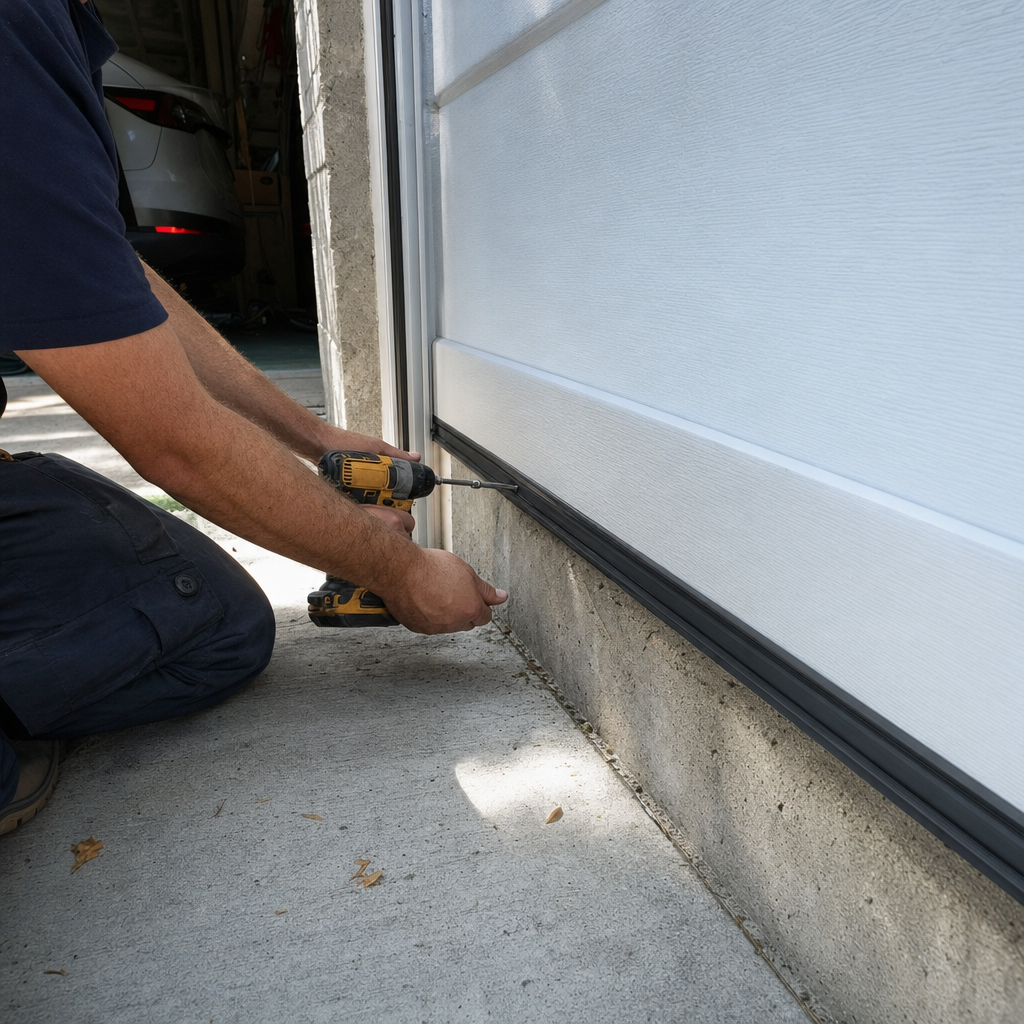
We learned this the hard way eight years ago. Edward Campbell, our owner and lead technician, pulled up to a Bridgeport bungalow with a standard 9-foot Clopay Canyon Ridge and spent the next three hours watching it not fit. The rough opening was 94 inches — a true 8-footer with settled jambs — and the homeowner had already taken the day off work. That’s the day we stopped trusting “standard” sizes and started carrying a tape measure before we carried a quote.
Why Chicago’s Garages Break Every National Cost Average
The internet will tell you a new garage door costs $1,000–$1,500. That’s a suburban 9×7 on a plumb opening with 12 inches of headroom and a level concrete apron. In Chicago, that garage barely exists.
Our alley grid — roughly 1,900 miles of rear lanes — funnels us into detached garages built between 1910 and 1955, sized for Model Ts and early Fords, not today’s crossovers. The typical call we get in Avondale, Jefferson Park, or Portage Park involves:
- An 8-foot-wide opening (sometimes 7’10” after decades of jamb settlement), not the modern 9-foot standard
- A low header under 10 feet finished height, which restricts section count and may force a flush top section instead of a standard raised panel
- A heaved or settled concrete apron from Chicago’s glacial clay expanding and contracting through freeze-thaw cycles
- Lake-effect moisture corrosion on tracks and hardware that outpaces anything you’ll see in national cost guides
Each of these conditions moves your job from “stock install” to “custom fit,” and that’s where the $700–$2,200 range actually lives. We’ve installed $750 doors and we’ve installed $2,100 doors in the same ZIP code, on the same block, because the garages were built in different decades by different carpenters with different ideas about what “square” meant.
How Opening Width Drives Material Cost
This is the detail no national guide breaks out, and it’s the single biggest variable in Chicago.
A standard 9×7 steel door ships from every distributor in America. An 8×7 or 8’6″ door does not. When your bungalow garage measures 95 inches rough opening — common in Bridgeport, Brighton Park, and the bungalow belt — you’re choosing between:
- A custom-width door from Clopay or Amarr (add $200–$400 to material cost, 2–3 week lead time)
- A narrow-stile 8-foot door with reduced panel width, which we keep in limited stock for same-week installation
- Structural modification to the opening — removing and reframing a jamb to accept a 9-footer (add $400–$600 in labor, permit implications in some Chicago wards)
We’ve stopped counting how many homeowners in Jefferson Park have told us, “The online estimator said $1,200.” It probably did — for a 9×7. Their opening is 8’2″. That gap is where Chicago installation costs diverge from every national average you’ll find.
Header Height: The Hidden Restriction
Low header height doesn’t just limit your door style — it changes your hardware and your insulation value.
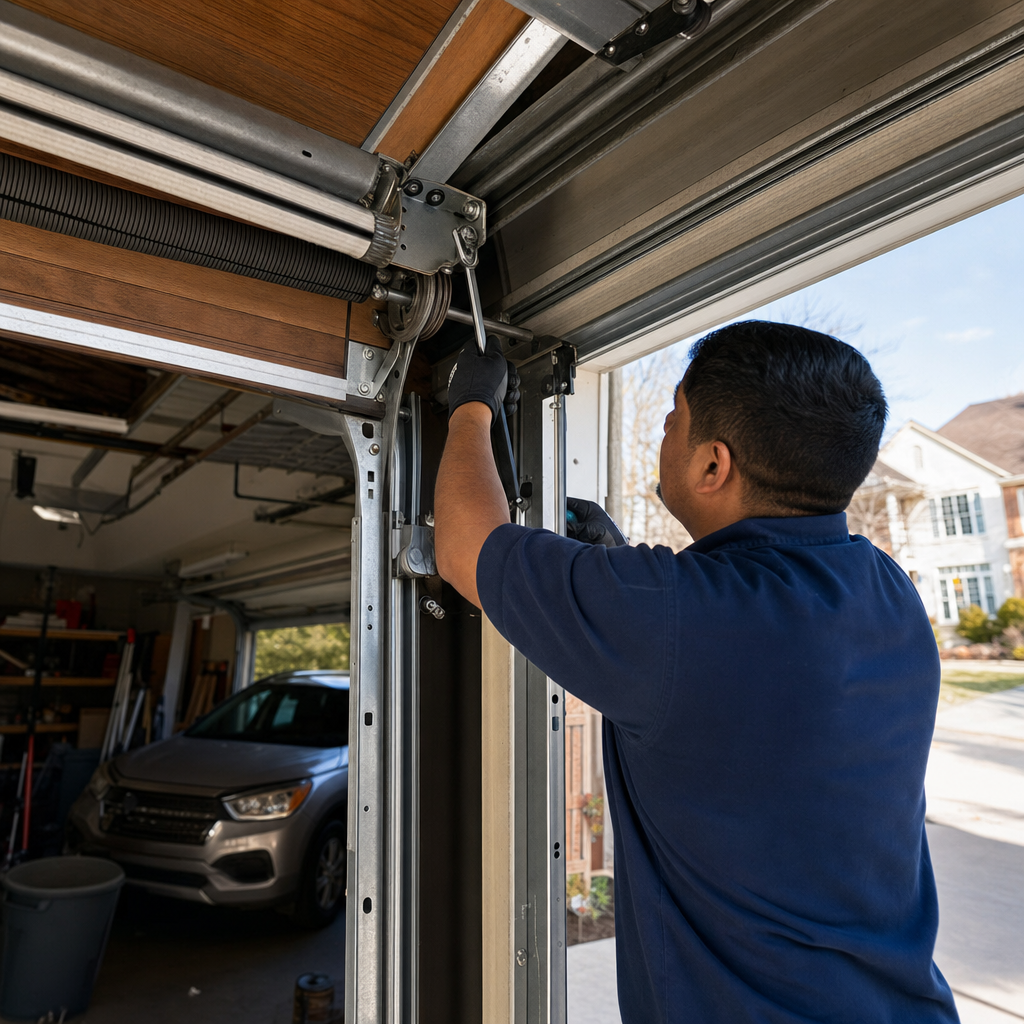
A standard 7-foot door uses four 21-inch sections. On a bungalow garage with 9’6″ to the finished header, you might need a flush top section or a low-headroom track assembly that shifts the torsion springs to the rear of the track instead of above the door. That hardware costs more, installs slower, and reduces your effective R-value because the flush section has less room for polyurethane foam.
In Chicago, that matters more than it does in Atlanta or Phoenix. Our annual temperature swing runs from -10°F to 90°F. A polyurethane-core door at R-16+ isn’t a luxury upgrade here — it’s what keeps your garage above freezing without boiling your heating bill, and it’s what prevents the thermal shock that cracks torsion springs in January. We’ve replaced springs in Portage Park garages where the interior face of an uninsulated door was 40 degrees colder than the exterior face on a sunny winter morning. That differential stresses everything: springs, cables, rollers, hinges.
When Edward specs a door for a Chicago install, he’s not checking a style catalog. He’s checking: opening width, header height, side-room for track, back-room for opener, apron level, and which way the prevailing wind hits the panel. The lake-facing garages in Edgewater and Rogers Park take a beating that inland garages don’t. We’ve seen east-facing Raynor doors rack out of square in four years from sustained wind load — not because the door was cheap, but because it was spec’d for a climate that doesn’t exist here.
What We Stock and What We Order
Lead time is cost. A door that takes three weeks to arrive means three weeks of a security gap, three weeks of weather intrusion, three weeks of your car sitting in the alley.
We keep Clopay Gallery Collection and Amarr Stratford steel doors in 8×7 and 9×7, insulated and uninsulated, at our Chicago supply point. These cover maybe 60% of our installs same-week. For everything else:
| Door Type / Scenario | Typical Lead Time | Price Impact vs. Stock |
|---|---|---|
| Standard 9×7 steel, insulated (Clopay/Amarr) | Same week | Baseline |
| Standard 8×7 steel, insulated | Same week | Baseline |
| Custom width 8’6″ or 7’10” steel | 2–3 weeks | +$200–$400 material |
| Wayne Dalton fiberglass or wood composite | 2–4 weeks | +$400–$800 material |
| Raynor aluminum full-view (modern style) | 3–4 weeks | +$600–$1,200 material |
| Flush top section for low header | 1–2 weeks | +$150–$250 material |
| Low-headroom track conversion kit | Same week | +$180–$320 hardware |
February is our busiest month for full replacements — spring failures cascade into “the whole door is 30 years old, just replace it” decisions. In February 2024, we had six Jefferson Park homeowners choose to wait three weeks for a custom-width Wayne Dalton rather than take a stock 9-footer that would’ve required reframing. Their garages, their timelines, their call. We just make sure they know the real options before they decide.
Real Chicago Installed Costs: Three Scenarios
These are actual job profiles from the past 18 months, anonymized but accurate. They show how the $700–$2,200 range actually distributes across Chicago’s housing stock.
Scenario A: Cooperative Opening, Stock Door — $850–$1,150
9×7 opening, plumb jambs, 12″ headroom, level apron. We install a Clopay Gallery Collection steel door, insulated, with standard extension springs and a Garage Door Installation package that includes haul-away of the old door. Done in four hours. This garage was a 1990s rebuild in North Center — the exception that proves Chicago’s rule.
Scenario B: Narrow Opening, Custom or Narrow-Stile Door — $1,100–$1,600
8-foot opening in a 1923 Bridgeport bungalow, settled jambs, 10’6″ header. We used an Amarr narrow-stile 8×7 with a low-headroom track kit. Required apron shimming to stop binding — the glacial clay heave had dropped the driver’s side corner 1.5 inches. Edward handled the job himself, as he does on every install; he spent the first hour leveling and the next three hanging. Total time: five hours. Customer’s previous door had been “repaired” three times by a franchise crew that never shimmed the apron.
Scenario C: Full Structural, Heaved Apron, Premium Insulation — $1,700–$2,200
Two-flat greystone garage in Avondale, 8’3″ opening with non-plumb jambs, 9’4″ header, apron heaved 2.25 inches on the alley side. We reframed one jamb, installed a Wayne Dalton insulated steel door with polyurethane core at R-16.5, low-headroom hardware, and new galvanized track rated for Chicago’s salt-moisture corrosion cycle. Required two visits: measure and prep, then install. This is the job that separates a technician from an installer — Edward’s mechanical training at Triton College’s vocational program shows up in the electrical and structural work, not just the door hanging.
| Service | Price Range |
|---|---|
| Spring Repair | $180–$340 |
| Cable Repair | $130–$250 |
| Opener Repair | $120–$320 |
| Opener Installation | $250–$550 |
| Panel Replacement | $250–$500 |
| Track Realignment | $120–$240 |
| Roller Replacement | $110–$220 |
| New Door Installation | $700–$2,200 |
| General Garage Door Repair | $150–$600 |
Insulation Value: Not Optional in Chicago
We get pushback on insulated doors every summer. “It’s just a garage.” Then January hits, and the same homeowner calls about a snapped spring, a cracked bottom seal, or a door that won’t close because the opener strain gauge trips from the torque required to move frozen hardware.
Here’s what we’ve measured on jobs across Chicago: an uninsulated steel door in a detached alley garage runs 25–35 degrees colder on the interior face than an R-16 polyurethane door on the same day. That differential drives condensation on the interior hardware, which freezes overnight, which expands and cracks rollers, which misaligns tracks, which strains springs. We’ve replaced three-year-old springs in uninsulated doors that should’ve lasted fifteen.
Our standard recommendation for any Chicago install: minimum R-12 polystyrene, preferably R-16+ polyurethane. The material upgrade pays for itself in hardware longevity, and it makes the garage usable for anything beyond parking from November through March.
We work on LiftMaster and Chamberlain openers exclusively for installs — their belt-drive models handle cold-start torque better than chain drives in subzero conditions, and their myQ integration actually works in Chicago’s concrete-and-brick alley environment where Wi-Fi signals struggle. For the door itself, Clopay, Amarr, Wayne Dalton, and Raynor are the brands we know inside and out, because we’ve installed and repaired all four across eight years and 365 customer reviews.
What “Free Estimate” Actually Means From Us
We’ll say it directly: some competitors use “free estimate” to get a foot in the door, then pressure for a same-day decision. We don’t. Edward Campbell measures your opening, checks your header, levels your apron, and emails a written quote with two or three door options and honest lead times. If your 8-foot opening can take a narrow-stile stock door same-week, he’ll tell you. If you need a custom order and it’s February, he’ll tell you that too — even if it means you wait, or call someone else, or repair the old door for another season.
That’s the “8 years, one standard” approach. We’ve built Regal Garage Door Repair on the principle that a homeowner who gets honest information makes a better long-term customer than one who gets a fast sale. Our 365 reviews at 4.8 stars aren’t from people we talked into things. They’re from people who got what they were promised, at the price they were quoted, by the owner himself.
Edward’s signature line, which he’ll use on your job site if you ask him anything about what your door is doing: “Tell me what it’s doing and I’ll tell you exactly what’s wrong — no guessing, no upselling.”
FAQs
New garage door installation in Chicago costs $700–$2,200 for most residential jobs, with the exact price depending on your opening width, header height, and whether your concrete apron needs leveling. Call (833) 895-4082 for a free, on-site measurement and written quote — estimates are free, and we stock 8-foot and 9-foot doors for same-week installation when possible.
Repair is cheaper short-term — most repairs we handle run $150–$600 — but if your door is pre-1990, uninsulated, or has a bent track from a heaved apron, a new door often costs less over five years than repeated service calls. We’ll tell you honestly which path makes sense when Edward measures your job; we’ve advised repair on doors we could’ve sold replacements for, because the math didn’t justify it.
Same-day installation is possible for stock 8×7 and 9×7 doors on cooperative openings in Chicago, especially in neighborhoods like Portage Park, Jefferson Park, and North Center where we keep inventory close. Custom-width doors, Wayne Dalton or Raynor special orders, or jobs requiring structural reframing need 1–3 weeks lead time. Call (833) 895-4082 — we’ll check stock against your opening size and give you a real timeline, not a booking gimmick.
Chicago’s alley garages are older, narrower, and structurally more variable than standard suburban construction — 8-foot openings, low headers, and heaved aprons from glacial clay are the norm, not the exception. These conditions require custom-width doors, low-headroom hardware, and concrete leveling that national cost guides don’t account for. We’ve installed doors in Chicago for eight years, and we’ve never seen a “standard” opening that matched the textbook.
Get Your Real Chicago Garage Door Quote
Don’t order a door for an opening you’ve never measured. In Chicago’s bungalow belt and greystone neighborhoods, the opening math comes first — and it’s almost never what the internet says it should be. Call (833) 895-4082 for a free, on-site estimate. Edward Campbell will measure your rough opening, check your header height and apron level, and give you a written quote with real lead times and real options. No guessing, no upselling, no standard-size door that doesn’t fit.
Written by Edward Campbell, Owner & Lead Technician at Regal Garage Door Repair Greater Chicago, serving Chicago, IL.