
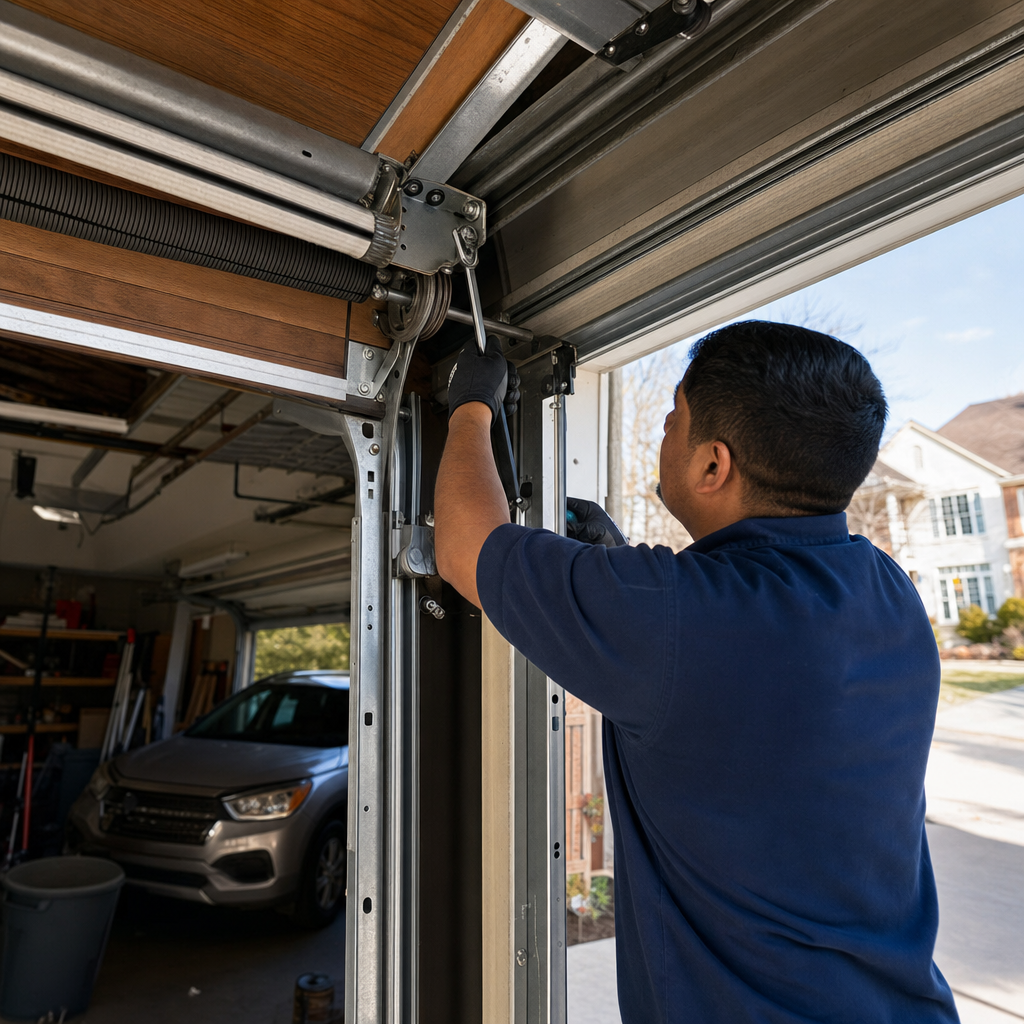
Garage Door Spring Replacement Cost in Chicago: What You’ll Actually Pay
Garage door spring replacement in Chicago typically runs $180–$340 for a standard torsion spring job, but in our city’s older alley garages, low headroom clearance often pushes that to $260–$490 once you account for the specialized hardware required. Same-day service is available at (833) 895-4082, and we don’t layer hidden “service call” fees on top of the repair price. Edward Campbell, our owner and lead technician, has handled this exact scenario hundreds of times across Chicago’s bungalow belt over the past eight years.
Why Most Online Price Quotes Mislead Chicago Homeowners
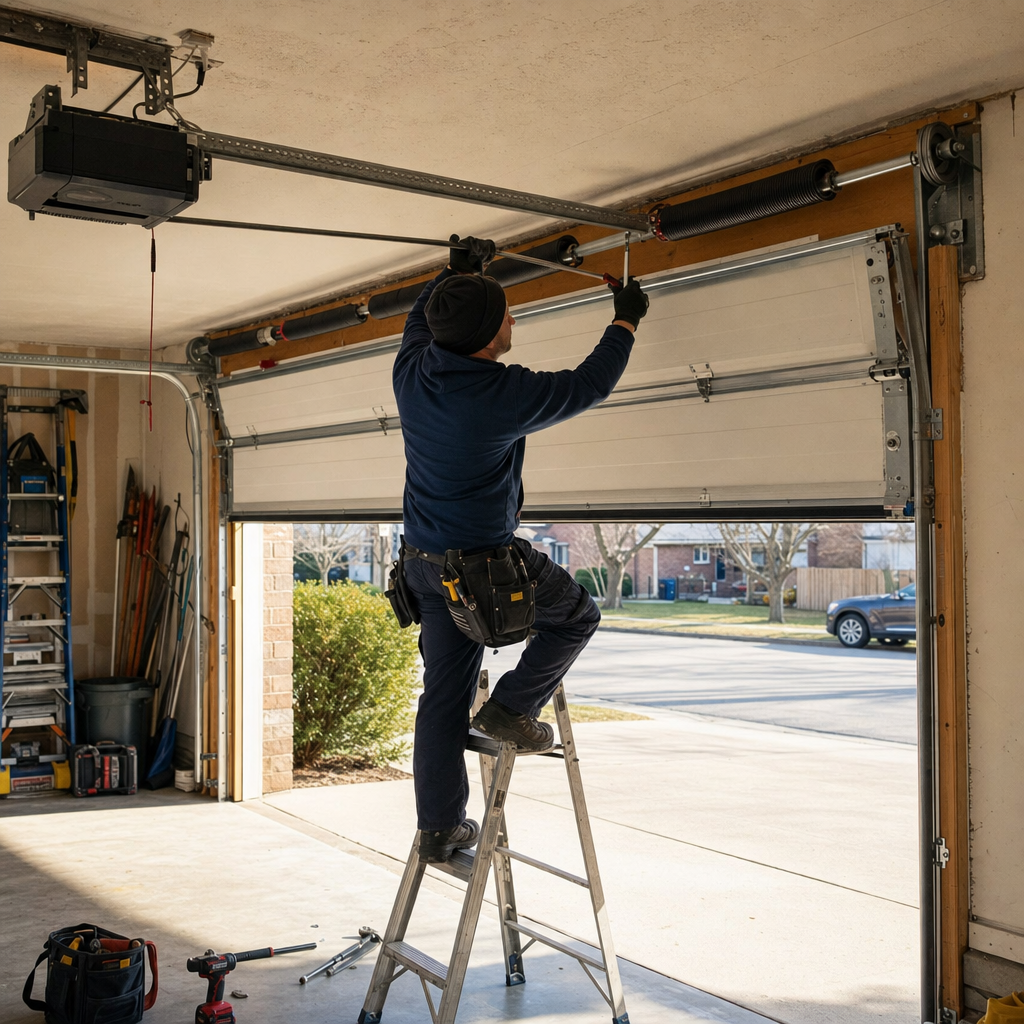
Here’s the gap nobody talks about: the national average figures you see assume 12 inches of headroom clearance above your garage door. Walk into any alley behind a Chicago bungalow in Bridgeport, Avondale, or Jefferson Park and measure. You’re looking at 10 inches. Sometimes 9. That two-inch deficit isn’t a minor detail — it eliminates standard torsion spring hardware entirely.
Low-clearance or EZ-Set torsion systems cost $80–$150 more in parts and require additional labor to configure. We’ve seen homeowners in Portage Park get quoted $190 online, then face a $320 invoice when the technician realizes the header situation. At Regal Garage Door Repair, we ask about your garage’s age and dimensions before we show up, so the number you hear on the phone is the number on the bill.
This matters because Chicago’s housing stock is genuinely different. The brick bungalow and two-flat greystone neighborhoods built between the 1890s and 1950s — which is most of the city’s residential core — came with single-car detached garages sized to early-20th-century automobiles. Eight-foot-wide openings are standard, not the 9-foot modern norm. Headers were cut tight to maximize interior space. Post-war garage additions are even more inconsistent, with improvised framing and non-plumb jambs that vary block to block.
When Edward Campbell grew up on the Northwest Side near Portage Park, helping his father maintain their two-flat, he learned early that Chicago buildings don’t follow textbook assumptions. That hands-on foundation, sharpened later through the mechanical program at Triton College in River Grove, is why we measure before we quote.
Chicago’s Peak Failure Season and What It Means for Pricing
January and February are our busiest months for spring replacement calls, and it’s not coincidence. Overnight temperatures in Chicago regularly drop below 0°F, and Lake Michigan’s lake-effect moisture drives aggressive freeze-thaw cycling that fatigues galvanized steel. The metal contracts sharply in extreme cold, then expands when daytime sun or a heated garage warms it — that thermal shock accumulates micro-fractures until the spring snaps, usually at the most inconvenient moment.
Emergency service during these peak weeks carries the same base labor rate at Regal Garage Door Repair, but demand means scheduling can tighten. We built emergency response into the business model from the start — when your door won’t move at 10 p.m. with a car trapped inside, you’re not calling for a luxury, you’re calling because you have no alternative. That said, if you’re reading this in October and your springs are showing rust, visible gaps, or a 3-inch stretch in the coils, addressing it preemptively avoids the winter premium entirely.
The lake’s influence extends beyond temperature. Sustained east winds off Lake Michigan create pressure loads on east-facing alley garage doors that gradually rack panels and stress spring windings beyond what inland climates produce. In neighborhoods like Edgewater and Rogers Park, we see accelerated wear patterns that suburban technicians simply don’t encounter.
Single Spring vs. Double Spring: The Replacement Rule for Chicago
Most residential garage doors use either one or two torsion springs. Single-spring setups are common on lighter 8-foot aluminum or steel doors; double-spring configurations handle heavier wood or insulated doors, or any 16-foot-wide two-car opening. When one spring in a pair snaps, homeowners naturally ask: can we just replace the broken one?
Technically, yes. We don’t recommend it for Chicago doors. Here’s why: the surviving spring has already endured the same thermal cycles, humidity exposure, and operational stress as its partner. It may look intact, but its cycle life is depleted. Replacing one and leaving the other creates an imbalanced torque load that strains the opener, warps the door panels, and guarantees a second service call within 6–18 months.
Edward’s approach is straightforward: “Tell me what it’s doing and I’ll tell you exactly what’s wrong — no guessing, no upselling.” When both springs need replacement, we quote both upfront. The labor to open the system and set tension is identical whether we’re swapping one or two, so the incremental cost of the second spring is typically just the part itself — usually $60–$90 additional. That’s cheaper than a return trip.
On 8-foot-wide vintage Chicago openings, spring winding specifications differ from modern 9-foot doors. Order the wrong spring — too long, too short, wrong inner diameter — and the door won’t balance. We’ve rescued jobs in Humboldt Park where a previous installer guessed the spec, installed an incompatible spring, and created a dangerous over-tension situation. Our working knowledge of Craftsman, Raynor, and LiftMaster hardware means we pull the right part the first time.
Chicago Garage Door Spring Replacement Cost Breakdown
These are the numbers we use for Chicago-area quotes. No hidden service fees, no trip charges layered underneath.
| Service | Price Range |
|---|---|
| Standard torsion spring replacement (12+ in. headroom) | $180–$340 |
| Low-clearance / EZ-Set torsion upgrade (under 12 in. headroom) | $260–$490 |
| Extension spring replacement (rarer on Chicago alley garages) | $150–$280 |
| Emergency same-day service (no after-hours surcharge) | $180–$490 |
| Double-spring replacement (both springs, standard headroom) | $240–$430 |
| Double-spring replacement (both springs, low clearance) | $320–$580 |
The low-clearance upgrade applies to roughly 60% of the detached alley garages we service in Chicago proper. If you’re unsure about your headroom, text us a photo of the header area above your closed door — we’ll tell you before we dispatch.
Common Local Scenarios We See
Every garage door failure has a context. These are the patterns that repeat across Chicago neighborhoods:
- The February morning snap in Logan Square: Torsion spring breaks at 6 a.m., car trapped, homeowner tries to lift the door manually and discovers a 150-pound slab won’t budge. We arrive same morning, measure the header at 9.5 inches, and install low-clearance hardware with a fresh spring set.
- The “balanced but noisy” door in Oak Park: Door opens but grinds and shudders. One spring has lost tension; the opener is compensating with extra force, burning out its motor. We replace both springs, check opener strain, and catch the LiftMaster gear before it strips — saving a $320 opener repair.
- The out-of-square binding door in Bridgeport: Chicago’s glacial clay has heaved the garage slab so the opening is visibly trapezoidal at the bottom. A previous technician kept adjusting tracks; we level the apron with composite shims first, then set proper spring tension. Door runs smooth for the first time in years.
- The post-addition garage in Albany Park: 1970s frame construction with non-standard rough opening, previous owner installed a Chamberlain opener on a door it was never meant to handle. We spec the correct spring weight for the actual door mass, not the label someone misread a decade ago.
Safety: Why Spring Work Isn’t a Weekend Project
Torsion springs store massive mechanical energy — enough to counterbalance 150–400 pounds of door weight. Winding or unwinding them without proper bars and training risks severe laceration, broken bones, or worse. The cones can explode under torque. We’ve been called to homes in Chicago where a well-intentioned homeowner’s DIY attempt turned a $240 repair into a door-off-tracks disaster requiring panel replacement.
If your spring is visibly broken — you’ll see a gap in the coil, or the door will slam shut when released from the opener — don’t attempt to adjust or remove it. Don’t stand under the door. Disengage the opener if you can do so safely, and call a trained technician. At Regal Garage Door Repair, Edward handles the job himself, not a subcontracted crew learning on your hardware.
FAQs
Most Chicago homeowners pay $180–$340 for standard torsion spring replacement, but low headroom clearance in older alley garages pushes 60% of jobs to $260–$490 with specialized hardware. We quote your actual garage, not a national average. Call (833) 895-4082 for a free estimate with no hidden fees.
A broken torsion spring cannot be repaired — it must be replaced. The only variable is whether you replace one spring or both, and whether your garage needs standard or low-clearance hardware. Replacing both springs together costs $60–$90 more upfront but prevents a second service call when the matching spring fails. Call (833) 895-4082 and we’ll tell you which applies to your door.
Yes — same-day service is standard at Regal Garage Door Repair, including evenings and weekends. Winter peak demand (January–February) can tighten afternoon slots, but we typically reach Chicago homeowners within 2–4 hours of calling. Emergency service carries no after-hours surcharge. Call (833) 895-4082 to check today’s availability.
Chicago’s sub-zero overnight temperatures cause steel springs to contract sharply, then expand during warmer daytime periods. That thermal cycling, accelerated by lake-effect humidity, accumulates metal fatigue until the spring snaps. January and February see our highest failure rates. If your springs are rusted or stretched, replacing them before winter hits prevents the emergency entirely. Call (833) 895-4082 for a preemptive inspection.
Get Your Exact Quote — No Surprises
We’ve replaced garage door springs across every Chicago neighborhood from the bungalow belt to the lakefront, on doors built in 1923 and doors built in 2023. Eight years, one standard: Edward Campbell diagnoses honestly, quotes accurately, and stands behind the work personally. Text a photo of your header area or describe your door’s behavior — we’ll give you a real number before we roll.
Call (833) 895-4082 for a free estimate. No service call fees, no upselling, no guessing on spring specs.
Written by Edward Campbell, Owner & Lead Technician at Regal Garage Door Repair Greater Chicago, serving Chicago, IL.